Travel Photography in China: Reading an Engineered River
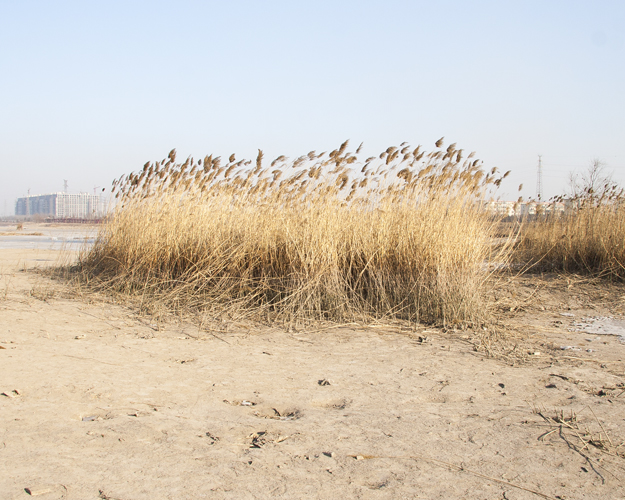
Travel photography in China is often framed as discovery: ancient sites, rapid change, the scale of cities, seen for the first time. My project, Taiyuan River, took a narrower path. I photographed the Fen River (汾河, Fén Hé) as it runs through Taiyuan, not as a natural boundary, but as a constructed axis, reshaped by reservoirs, removable structures, and controlled vegetation until nature reads as infrastructure. The work asks how travel photography can describe regulation, made visible in land, rather than the drama of arrival itself.
Arriving without a story
I lived and worked in China before settling in the Basque Country. That experience did not give me a story to illustrate in Taiyuan; it gave me patience for places that refuse immediate narrative. When I returned with a 4×5 camera, I did not search for the image that confirms China as the viewer already imagines it. I searched for a territorial condition I could read slowly: a river whose form had been decided elsewhere, by intervention, rather than by geography alone.
Arriving without a story protects documentary travel work from illustration. The Fen River is not a symbol of modernization in my project. It is a specific, managed landscape in a specific city. Large format film enforces that specificity. Each exposure on color slide is final; you cannot assemble a thesis from hundreds of files afterward. You must decide what the river is offering on that day: light, water level, vegetation, structure, and whether your reading is honest before the shutter releases.
A week in Taiyuan produced fewer frames than a day with a digital camera would allow. That scarcity is not failure. It is the method. Travel becomes contact, rather than collection, when each sheet carries the weight of a decision that could not be made elsewhere.
Rivers as Infrastructure
The Fen River runs through Taiyuan as a managed landscape. Artificial reservoirs, removable structures, and controlled vegetation transform it into a regulated environment, nature reorganized as infrastructure. The river no longer functions primarily as a geographic element. It functions as a system: water held, released, bordered, planted, maintained.
Photographing that system requires looking past scenic water toward evidence of management: edges, barriers, planting patterns, structures that appear temporary yet persist. The project observes friction between engineered space and the land it replaces. Documentary photography, here, describes how control becomes visible, without needing to name the institutions that exert it.
That reading connects directly to Just Water, a series made in Spain, where water operates as a managed resource rather than as neutral nature. Taiyuan and Just Water belong to different countries and scales but share a question: How does infrastructure rewrite territory until the boundary between natural process and human intervention becomes indistinct? Travel photography, across my work, often begins with that indistinction, not with mountains or monuments, but with systems embedded in land.
Everyday use vs. control:
Managed rivers still receive everyday use, movement along banks, incidental presence, contingency that regulation cannot fully erase. The project focuses on moments where artificial order is visible, yet incomplete: where control and ordinary life coexist in the same frame. The landscape appears suspended between plan and accident.
That suspension is the documentary subject. An entirely controlled river, photographed as perfection, would illustrate policy. A river photographed only in disorder would deny the engineering that shapes it. The work lives between: order readable, contingency present. Observation, not argument: The viewer senses both the system and what escapes it.
In 4×5 film, those moments cannot be hunted in volume. You wait for alignment (light, structure, the relation between water and edge), knowing the river may not offer it today. Travel photography in large format is conditional in that sense. You return to the same stretch of bank, not for novelty, but because yesterday's reading was incomplete.
Color film in industrial light
Taiyuan's light carries industrial and urban particulate character, not the clean saturation of coastal tourism or high mountain clarity. Color slide film records that condition without the corrective flexibility of raw digital files. Exposure commits to the river as it appears: tonal balance, haze, the specific rendering of vegetation against concrete or stone.
I work in color deliberately across my practice. The documentary content of these landscapes is embedded in how places actually look: managed green against engineered grey, water reflecting sky, filtered through urban atmosphere. Black and white might simplify the reading into abstraction; color keeps the photograph tied to evidence. Industrial light is not an obstacle to overcome in post-production. It is part of what Taiyuan is.
The photographs were digitized at maximum resolution and conceived for large-scale prints, approximately 120 × 100 cm, scale that allows a viewer to enter the surface of water and bank, as I did at the tripod, reading detail that thumbnail travel images cannot hold.
Connecting China to other territories,
Taiyuan River is not an isolated chapter labelled China. It belongs to an international body of work united by method: slow reading of how territories are altered by water management, by building ratios, by extraction, by military withdrawal. In Tokyo, Yose Kiritsu reads urban density through regulation. In Spain, quarries read extraction as geometry. In Menorca, Enclusa reads abandonment, reclaimed by growth. China enters that constellation through the Fen River's engineered axis.
What connects these projects is not nationality, but attention: the same 4×5 discipline applied wherever I work. Germany and the United States also shaped my understanding of place before they appeared as named series on the site. Travel, for me, accumulates capacity: the ability to recognize a project when you encounter it, at home or abroad, because you have learned to read infrastructure, absence, and control as photographic subjects.
If you travel to China with a camera, consider whether your images describe the country you expected, or the condition the place actually presents. An engineered river in Taiyuan is not a postcard. It is a regulated environment, waiting for a reader slow enough to see it, one sheet at a time, without a story decided in advance.
Manuel Pinar