Travel Photography with a 4×5 Large Format Camera
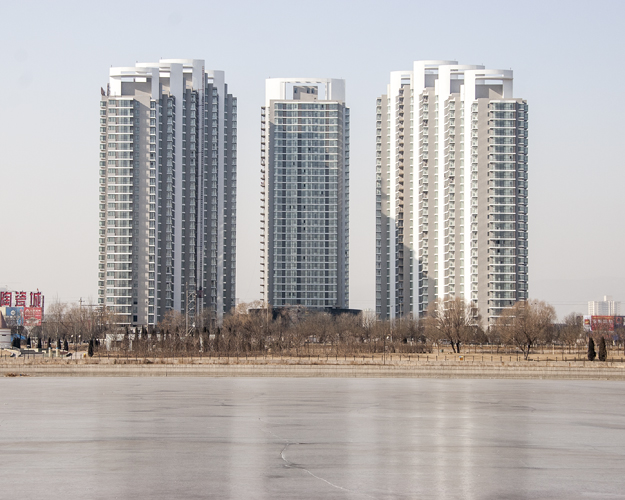
Travel photography is often associated with mobility, light cameras, rapid movement, the freedom to respond to whatever appears. My practice has developed in the opposite direction. I work with a 4×5 large format camera on colour slide film, and I have carried that way of working to China, Japan, Germany, the United States and across Spain. People sometimes ask whether large format and travel are compatible. They are, but only if you accept that travel, in this context, is not about covering ground. It is about staying long enough for a place to become readable.
Why slow travel
I lived and worked in the United States, Germany and China before settling in the Basque Country. Those years did not feel like a series of trips; they were extended presence in other territories. That experience shaped how I travel with a camera. I am not looking for the image that confirms arrival: the landmark, the postcard view, the instant recognition of a country. I am looking for the condition of a place: how infrastructure organises land, how use leaves traces, how absence becomes visible when function is removed.
Slow travel, for me, means reducing the number of locations and increasing the depth of attention at each one. A week in Taiyuan produces fewer frames than a day with a digital camera, but each frame carries the weight of a decision that could not be made elsewhere. Travel becomes less about collection and more about contact. The 4×5 camera enforces that contact because it cannot be used casually. You must stop, set up, measure, wait. The place enters the photograph through that pause.
Logistics without drama
Large format travel is practical if you keep the system simple. I work with a field camera, a modest number of lenses, film holders loaded before each working session, and a tripod I trust in wind. Film travels in lead bags through airport security; I have never found this to be the obstacle people imagine, provided you allow time and communicate clearly. The real logistics are not at the airport; they are in the day itself: where the light falls, whether conditions justify an exposure, how long you can remain in a location without turning the act of looking into performance.
I do not carry a mobile darkroom or develop on the road. The discipline is in the exposure, not in immediate verification. That uncertainty is part of travel on film. You leave a country with sheets of latent images and memory of places that may or may not survive the scan. There is no nightly review on a screen, no correction of a missed moment. You learn to trust the process you have built over years: the same process I use in Menorca or Andalucía, applied to unfamiliar ground.
One sheet, one decision
On colour slide film, each 4×5 exposure is final. There is no bracketing your way to safety, no assembling a composite from multiple frames. Travel intensifies that constraint because you may not return to the same corner of a city, the same bend of a river, the same quarry face. One sheet, one decision: that is the contract.
The decision is not only technical, aperture, shutter, tilt, but interpretive. What is this place offering today? In Taiyuan, the Fen River appears not as a natural boundary but as a managed axis, reshaped by reservoirs and controlled vegetation. The photograph had to describe that artificial order without reducing it to a slogan about modernisation. In Tokyo, the Yosekiritsu project required reading building ratios and urban density through repeated forms in residential districts: a different kind of travel, less geographic spectacle, more structural observation.
One sheet forces humility. You will miss images. You will also make photographs you could not have made any other way, because the cost of each exposure filters out the illustrative and keeps what survives the filter: what the place actually asked for.
Projects across countries
My travel work is not a single archive labelled by country. It is a set of projects, each rooted in a territorial question. Taiyuan River examines an engineered river in China. Yosekiritsu reads urban regulation in Tokyo. Other work remains anchored in Spain (Menorca, Andalucía, Seseña) while sharing the same method. What connects these projects is not nationality but attention: the same slow reading applied wherever I am.
Germany and the United States entered my life before they entered my portfolio as named series, but they informed how I understand displacement and scale. A European Union scholarship took me to Southern Germany; living in the United States taught me distance and grid. When I later photograph a quarry or a peripheral housing development, those experiences of other landscapes sit quietly behind the frame. Travel does not always produce a project immediately. Sometimes it produces the capacity to recognise a project when you encounter it at home.
The complete index of this work (Spanish and international) is gathered on the page Large Format Photography in Spain, which describes both the process and the projects, regardless of where each was made.
What travel loses and gains on large format
What you lose is coverage. You will not document every district, every hour, every variation of light in a single journey. You will not compete with the traveller who returns with thousands of files and selects twenty. What you gain is coherence. Each journey tends toward a small number of observations that belong together: a river managed beyond recognition, building density expressed through proportion, a landscape paused outside its tourist function.
Large format travel also changes your relationship to time abroad. You spend less energy moving and more energy standing still. That stillness can feel unproductive in a culture that measures travel by how much you have seen. I measure it by whether the photographs from a trip still make sense years later, whether they describe the place or only the fact that you were there. The former survives. The latter fades.
If you are considering travel with a 4×5 camera, my advice is simple: travel as if you live there briefly, not as if you are passing through with a checklist. Choose fewer subjects. Return to the same location when possible. Let the camera's slowness set the pace rather than fighting it. Travel photography on large format is not a contradiction. It is a commitment to a particular kind of seeing, one sheet at a time, in places that deserve more than a glance.
Manuel Pinar