Typology and Memory in Travel Photography
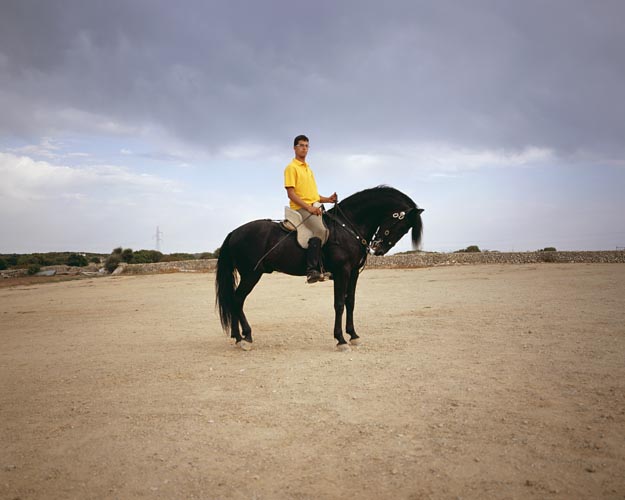
Travel photography often chases difference: the unfamiliar scene, the decisive moment of arrival. My project Series Genets, made on Menorca, works differently. It stays with a presence I already know: the Menorcan horse, a dark contained form within the island's landscape, embedded in shared cultural memory. The series is not a documentary about the animal. It is a typological study of how that presence structures space: how gesture and stillness hold a balance between body and environment without turning the horse into spectacle.
Presence without spectacle
Spectacle demands display: the horse as performance, as symbol, as postcard. Presence, as I use the word, is quieter. The horse appears in the frame as a condition of the landscape rather than as its star. I approached the Menorcan horse not to document breeds or traditions but to observe how a living form organises what surrounds it: distance, ground, sky, the edge of a field.
On 4×5 colour slide film, that restraint is enforced technically as well as visually. Each exposure is a commitment. You cannot chase a running animal across a field and hope to recover the image later. You wait for stillness, or for a gesture contained enough to read at large scale: the prints are conceived at approximately 120 × 100 cm. Presence, in that sense, is also a practical requirement. The camera rewards what holds still long enough to be seen clearly.
The work avoids the narrative of the exotic. Menorca is often photographed as destination, coast, season, tourism. Series Genets belongs to the island I know from living there, not from passing through. Travel, here, means depth in a familiar territory rather than coverage of a foreign one. The horse carries memory because the island carries memory; the photograph does not need to explain either.
Repetition as method
Typology depends on repetition. A single image of a horse in a field is an anecdote. A series built from restrained, repeated observations begins to describe a relation, between animal and land, between form and context, between images that rhyme without becoming identical.
I have used repetition elsewhere on the same island. Walking Around follows itinerant fair structures across Menorca with a fixed framing: the subject constant, the environment changing. Series Genets inverts part of that logic: the landscape shifts, but the presence is always the horse, always the dark form, always the question of how body and territory share the frame. Both projects rely on compositional discipline rather than on hunting variety. Repetition reveals what a single visit cannot: subtle differences in posture, distance and context that only become visible when sameness is established first.
That method connects travel photography to documentary observation. You are not collecting scenes; you are testing a relation across time. Each sheet of film asks whether today's encounter adds something the previous exposures did not, not novelty for its own sake, but refinement of a typology moving between representation and abstraction.
Body and territory
The central tension in Series Genets is between body and territory. The horse structures the image without dominating it. Too close, and the work becomes portraiture. Too distant, and the presence dissolves into general landscape. Large format demands that balance be resolved before the shutter releases, there is limited room to correct interpretation later.
I think of the body here as spatial fact rather than character. Gesture matters, but not as expression in a human sense. Stillness matters as a form of relation: the animal paused within an environment that continues around it. The territory is not backdrop. It is the other half of the equation: Menorcan ground, light, enclosure or openness, the cultural landscape that makes the horse readable as Menorcan rather than generic.
That reading does not require local knowledge, but it is strengthened by it. A viewer unfamiliar with the island may see a dark form in open land. A viewer who knows Menorca may feel the weight of association, agricultural life, local identity, a creature that belongs to the island's image of itself. The photograph should work in both registers without forcing either.
Menorca's cultural landscape
Menorca appears across several of my projects, Enclusa, Closed Island, Walking Around, Series Genets, each approaching a different condition of the same territory. Enclusa examines military withdrawal and botanical reclamation. Closed Island observes the island outside tourist season. Walking Around reads temporary architecture in motion. Series Genets reads cultural presence embedded in land.
Cultural landscape, as I understand it, is not folklore photographed for decoration. It is the visible layer of how a place understands itself: what repeats, what remains, what organises daily space. The Menorcan horse belongs to that layer. Memory operates collectively as well as personally: the horse is not my private symbol but a shared reference, which is why the work treats it as presence rather than as autobiography.
Working on the island where I was born gives travel photography a particular character. I am not discovering Menorca; I am returning to it with a camera slow enough to notice what familiarity usually hides. Series Genets is part of that return, alongside Enclusa's long study of a single site, alongside the seasonal pause of Closed Island. Together they map an island not as scenery but as working territory.
Building a typology over time
A typology is not completed in one season. Series Genets accumulated across encounters (different grounds, distances, postures) until the series could be read as a whole. Editing then became the final act of observation: removing frames that repeated without adding relation, keeping those that advanced the balance between representation and abstraction.
Travel photography, in this form, does not end when the journey ends. Menorca is not a destination I leave and summarise. It is a territory I revisit, and the typology grows with each return. That continuity distinguishes the project from travel-as-collection. The goal is not to show that I was there, but to show how a presence persists across places and moments on the island: how memory and form align when repetition is taken seriously.
If you are building a travel series of your own, consider whether your subject can sustain repetition without becoming a catalogue. Look for what structures the frame beyond spectacle, body, architecture, infrastructure, pause. Stay long enough for variation to mean something. On large format film, that patience is not optional. It is the method through which typology and memory become the same work.
Manuel Pinar