How Repetition Builds a Travel Photography Series
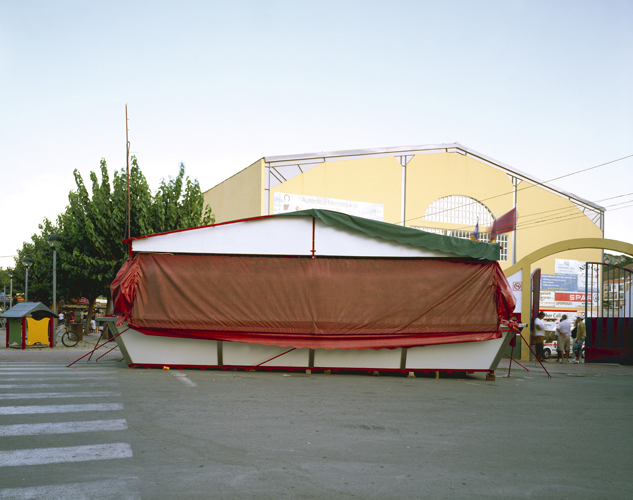
Travel photography often rewards variety: new cities, new light, new subjects, accumulated into a portfolio of differences. My project, Walking Around, works in the opposite direction. It follows itinerant fair structures across the island of Menorca, built around the repetition of a fixed framing, where the subject remains constant while the environment changes. The series is travel photography in a literal sense; these kiosks move through the island, but its method refuses the postcard logic of novelty. Repetition, not discovery, is what builds the work.
Travel without the postcard.
The postcard assumes that travel is proven through spectacle: a landmark, a coastline, a view that could belong nowhere else. Fair kiosks refuse that role. They are temporary, functional, visually modest structures designed to arrive, operate, and leave. Photographing them across Menorca is travel work that does not depend on iconic scenery. The island provides context, not destination.
I was born in Menorca, and have returned to it across many projects. That familiarity matters. Travel photography here is not the gaze of a visitor collecting impressions in a week. It is sustained observation of a territory I know, in different seasons and rhythms: including the pause that Closed Island describes, when the island outside tourist season enters a state of temporary closure and infrastructures remain while their function is inactive. Walking Around occupies a related condition: structures in motion through a landscape that is itself familiar, not exotic.
Working without the postcard also means accepting that the photographs may not announce their location immediately. A fair kiosk in one village resembles the same kiosk elsewhere. That sameness is deliberate. Travel, in this series, is displacement rather than scenery, movement through place without the reassurance of a recognizable view.
One frame, many places.
The compositional rule is simple and strict: maintain the same framing strategy throughout. The kiosk occupies a consistent position within the 4×5 frame; the camera distance, angle, and proportion remain stable across locations. What changes is everything around it, ground, buildings, sky, the incidental details of each stop on the fair's route.
Large format film makes that discipline tangible. Each exposure on color slide is a commitment. You cannot later crop your way toward consistency, or assemble a typology from loosely related frames. The repetition must exist at the moment of exposure, in how you stand, how you level the camera, how you accept or reject a site because it breaks the rule you have set for yourself.
One frame, many places produces a series that reads as a single visual sentence, repeated with different endings. The viewer compares, without being told to compare. Subtle differences (a wall behind the kiosk, open field, a road cutting the background) become the content. Without the fixed frame, those differences would remain anecdotal. With it, they accumulate into meaning.
Displacement as Subject
Each image records the presence of these temporary constructions as they move through different contexts, revealing a form of quiet displacement. The structures appear detached from their surroundings, existing in a continuous state of transition. That is not a metaphor imposed after the fact; it is what the fair system produces. The kiosk belongs nowhere permanently. Its identity is itinerant.
Displacement as subject shifts travel photography away from where you went, and toward how things exist in relation to place. The kiosk is always slightly wrong for its background, too colorful for a grey street, too provisional for permanent architecture, too small to anchor a landscape. That tension between permanence and movement is the work's central observation. The subject travels; the photographer follows; the frame stays still.
I have approached repetition differently elsewhere, on the same island. Series Genets observes the Menorcan horse as a contained presence within landscape, gesture, and stillness, subtle variation in posture and distance. There, the subject is biological and cultural; here, it is architectural and economic. Both projects rely on sameness, established first, so that difference becomes visible only across the series.
The fair as temporary architecture
Fair kiosks are temporary architecture in the most literal sense: assembled, used, dismantled, transported. They carry the visual language of function (signage, counters, awnings), without the ambition of permanent building. Photographing them treats popular architecture as seriously as any monumental structure, but on the terms the subject offers: modest scale, bright color, provisional materials.
Temporary architecture also describes a relationship to time. The fair arrives; the island accommodates it; the fair leaves. Walking Around does not document the event, crowds, rides, noise, but the structural residue of that cycle. The kiosk, standing in an empty square or at the edge of a road, describes a form of life that is periodic rather than continuous. Travel photography rarely attends to that rhythm; it prefers the exceptional moment. Repetition across the fair's route makes the periodic visible.
On 4×5 color slides, those structures retain the specificity of their surfaces, painted metal, fabric, plastic, the small declarations of commerce. Large-scale prints, at approximately 120 × 100 cm, allow that material detail to hold at exhibition distance. Temporary architecture, photographed with permanence in mind, acquires a weight its builders never intended.
Editing a series from sameness:
Editing Walking Around is not a search for the strongest single image. It is the construction of a field from frames that resemble each other. Images that break the typology (inconsistent distance, an angle that shifts the kiosk's role in the frame) are removed regardless of their isolated merit. The series protects its rule because the rule is the work.
Sameness also governs order. I sequence to establish the method early, then allow variation to unfold gradually: different grounds, different degrees of isolation, moments when the kiosk appears almost absorbed by its context, and moments when it reads as entirely foreign. The viewer should feel comparison before they name it. Editing from sameness means resisting the impulse to punctuate the sequence with a dramatic outlier.
That editing logic connects Walking Around to other serial works in my practice.In Tokyo´s project, where building ratios repeat across urban space; Quarries, where extraction produces rhyming geometries. The subject changes; the principle remains: A travel or territorial series is built when repetition reveals what a single visit cannot. If you are assembling a travel portfolio from unrelated highlights, you have a collection. If you are holding one frame across many places, until difference becomes readable, you have a series.
Manuel Pinar