Documentary Photography: Observation vs. Illustration
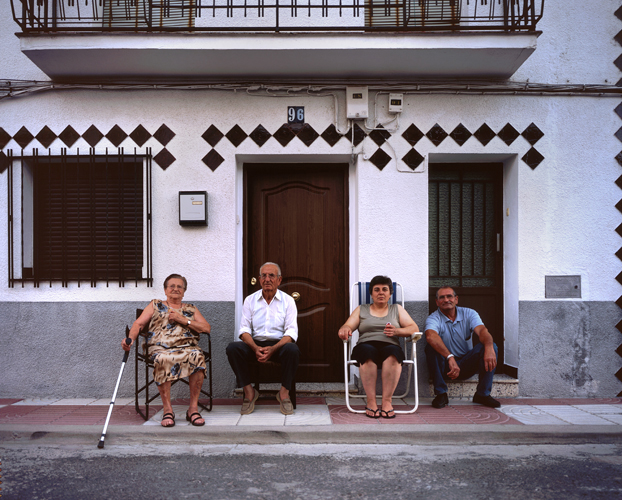
Documentary photography is often understood as proof: an image that shows something happened, or that a condition exists. That definition is not wrong, but it is incomplete. Much of my work is described as documentary, yet I am rarely trying to prove a thesis in a single frame. I am trying to observe a territory until the photograph stops performing its subject and begins to hold the place itself, its logic, its tension, its silence. The difference between observation and illustration is, for me, the difference between a project that endures and a picture that merely explains itself.
The trap of the obvious image
Every landscape carries a ready-made photograph. A quarry looks like extraction. An abandoned base looks like ruin. A peripheral housing development looks like speculation. Those readings are available immediately, and the camera can confirm them without difficulty. I think of these as illustrative images: they arrive before the photographer, fully formed, asking only to be reproduced.
Illustration is seductive because it communicates quickly. Editors understand it. Audiences read it without effort. But illustration closes the work too early. Once the viewer recognises the theme, the image has nothing left to offer. The photograph becomes a caption made visible. In my experience, the most limiting work I have made, or nearly made, was work that knew its argument before the exposure was taken.
Observation begins when you refuse the obvious frame. It requires asking not what a place represents, but how it behaves: what structures repeat, what absences shape the ground, what the light reveals when you stop looking for the expected subject. That shift is not aesthetic. It is ethical. It acknowledges that a territory is more than the idea it can be used to support.
Staying with a place
Observation takes time, not only clock time, but attention sustained across returns. A single visit produces illustrations because the photographer is still negotiating with the novelty of the site. Familiarity removes novelty and replaces it with nuance. You begin to see what does not change and what changes slowly. You notice the secondary detail that carries the weight of the frame.
In Just Water, water is never the subject in the conventional sense. The project examines how water is managed (redirected, contained, redefined) through the landscapes built around it. I could have produced illustrative images of scarcity or abundance, symbols that would read immediately. Instead, the work moves through infrastructures and terrains where water's presence is indirect, where the political and environmental conditions are embedded in surfaces that appear, at first, neutral. That required staying with each location until the frame could carry complexity without announcing it.
Large format film supports this discipline. Each exposure on 4×5 colour slide is deliberate. You cannot respond to a place by accumulating hundreds of variations and selecting later. You must decide what the place is offering at that moment, and whether your reading is honest. Observation, in that sense, is not passive. It is a continuous judgement about what the landscape is actually doing, as opposed to what you would like it to mean.
Enclusa as turning point
If there is a project where this distinction became clear to me, it is S'Enclusa. The site on Menorca (a former United States military communications base, abandoned since the 1990s) invites illustration at every turn. Ruin, nature reclaiming architecture, the end of the Cold War: the themes write themselves. I began with typological images of barracks because that was the readable layer.
Repeated visits shifted the work. Vegetation became the dominant force in the frame. The military function receded. I was no longer illustrating abandonment; I was observing an equilibrium between control and decay that had no single moral. The series grew to sixteen photographs, each titled after a plant appearing in the image, in Latin and in Menorquín. That naming was part of the observation: an acknowledgement that the living element was not metaphor but subject.
I have written elsewhere about why I began that project and why I returned to the same landscape. What matters here is methodological: Enclusa taught me that documentary photography, at least in the way I practise it, is not about finding images that support a known story. It is about allowing the place to revise your story until the photographs describe a condition rather than an opinion.
Sequencing meaning
A single observational photograph can stand alone, but documentary work, for me, lives in sequence. Meaning accumulates across repetitions, rhymes and shifts in scale. An isolated frame may still illustrate. A series can observe.
Sequencing is where observation becomes argument without becoming propaganda. The order of images does not tell the viewer what to conclude; it establishes a field of relations, between architecture and growth, infrastructure and land, presence and absence, and allows the viewer to move through that field at their own pace. In Just Water, the sequence follows managed landscapes rather than dramatic events. In Enclusa, it follows the gradual displacement of function by ecology. Neither series relies on a single emblematic image, because observation distributed across many frames is harder to reduce to a slogan.
Editing, then, is not separate from documentary practice. It is the final act of observation: the moment you ask whether the body of work describes the place faithfully, or whether one strong frame has distorted the whole. I discard images that illustrate too efficiently, however competent they may be as photographs.
For collectors and editors
Collectors and editors sometimes approach documentary work looking for the image that states the theme most clearly. I understand that impulse. Illustrative photographs are legible in a portfolio review or on a wall at a glance. Observational work asks for more time, time to move through the sequence, to read the surface, to accept ambiguity.
What I can offer is work that rewards that time: large-format colour prints conceived at approximately 120 × 100 cm, produced from 4×5 slide film scanned at maximum resolution, intended for sustained viewing rather than immediate consumption. The documentary content is present, territory, use, memory, infrastructure, but it is embedded in the visual condition of the place rather than displayed as a message.
If you are a curator, editor or collector evaluating this kind of work, the question I would suggest is not only what the photograph is about, but whether it would still matter if you did not already know the theme. Observation survives that test. Illustration often does not. That distinction has guided my practice for years, and it is the standard I continue to apply to every project I begin.
Further reading: Why I Photographed the Enclusa Project · Why Returning to the Same Landscape Changes Your Photography
Manuel Pinar