Isolation in the Landscape: Documentary Photography Beyond the Headline
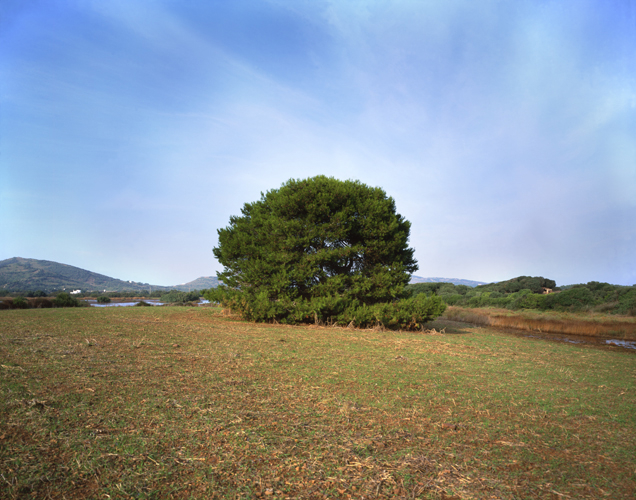
Documentary photography is often expected to respond to events, to illustrate what has already entered public consciousness. My project Lonely Bush moves in a different direction. Made at the beginning of the 2000s, during a period of geopolitical tension associated with the presidency of George W. Bush and the invasion of Iraq, supported unevenly across the international community: the work does not document that conflict directly. It builds a parallel reading between landscape and history, where isolation operates as both form and concept. The photograph holds a condition rather than a headline.
Form before event
When news photography answers an event, the event organises the frame. When landscape photography observes a territory, form organises the frame first: proportion, distance, the relation between a minimal presence and the space surrounding it. Lonely Bush began from that priority. I was interested in isolated elements within open land: a bush, a solitary structure, a presence reduced to its bare condition, detached from obvious context and support.
The political reference in the project's title was not an afterthought applied to neutral images. It emerged from the double meaning of the word itself, bush as plant, bush as name, and from living through a moment when international alignment fractured around a single decision. The work does not show that decision. It asks whether a landscape can carry the feeling of that moment without depicting it. Form comes first; the historical resonance follows if the form earns it.
That order protects the work from becoming illustration. An illustrative photograph of the Iraq war would show what everyone already recognises, military presence, protest, flags, casualties. A landscape photograph of isolation can suggest vulnerability, exposure, unsupported presence, but only if the visual evidence is honest. The bush in the field must first be a bush in the field. The reading opens from there.
Parallel readings
Parallel reading is the structural principle of the project. The images oscillate between two registers: the literal (a solitary element in open space, and the associative) political isolation, diplomatic distance, a name attached to a contested era. Neither register cancels the other. The viewer may enter through form alone and remain there. Or the title may activate a second layer without the image needing to confirm it explicitly.
I have used parallel structure elsewhere, though less openly. Closed Island reads Menorca outside tourist season as a territory in pause, infrastructures present, function suspended. The isolation there is seasonal and spatial. In Lonely Bush, isolation is reduced further: minimal presence, maximum surround. Andalucía integrates figure and landscape with neutral coexistence; Lonely Bush removes the social field almost entirely. What remains is exposure: a condition that can be read politically only because it has been seen visually first.
Parallel readings require restraint. If the political layer dominates, the landscape becomes a prop. If the landscape refuses all association, the title becomes a joke. Editing and sequencing (choosing which isolations to include, how much sky, how much ground) calibrate that balance. The work succeeds when both readings remain possible and neither feels forced.
Open space, minimal presence
The formal grammar of Lonely Bush is simple: open space, minimal presence. On 4×5 colour slide film, that simplicity is demanding. Large format does not allow rapid accumulation of variations. Each sheet commits to a specific distance and a specific relation between the isolated element and the field around it. Too close, and the image becomes botanical detail. Too far, and presence dissolves into general landscape.
I looked for conditions where support was visibly withdrawn: where whatever stands in the frame appears without the context that would normally explain it. That visual logic connects to how I work across projects: peripheral housing before the city arrives, military structures after function ends, tourist infrastructure without tourists. Lonely Bush compresses that logic to its minimum. One element, one surround, one exposure.
The prints are conceived at approximately 120 × 100 cm. At that scale, emptiness is not empty; it becomes a physical pressure in the room. Minimal presence reads as vulnerability because the viewer shares the surround. Standing before the print, you occupy the same open field the camera recorded. That spatial experience is part of the work's meaning, not an incidental consequence of size.
Documentary ethics
Documentary ethics, as I understand them, do not require the photographer to disappear. They require honesty about what the frame can and cannot claim. Lonely Bush does not pretend to report from Iraq. It does not substitute a bush for a casualty or a horizon for a policy. It acknowledges a historical moment the photographer lived through, as someone who began in daily photojournalism and later moved toward personal landscape work, without claiming a documentary authority the images do not possess.
That distinction matters increasingly when every landscape can be recruited as metaphor. I resist recruitment that bypasses observation. The ethical standard I apply is the one I have described in other Field Notes: would the photograph still matter if you did not already know the theme? The isolated form must survive without the title. The title may then deepen a reading that the form has already made credible.
Not illustrating the news does not mean ignoring history. It means refusing to compress history into a single emblematic image when the condition history produces is diffuse, uneven support, exposed isolation, a long aftermath. Documentary landscape work can address that diffuseness by staying with form long enough for association to arrive as recognition rather than as slogan.
When personal experience meets history
Personal experience enters this project through lived time rather than through autobiographical content. The early 2000s were a period when political language saturated daily life, in media, in conversation, in the sense that international relations had narrowed around a single axis of decision. I did not photograph those conversations. I photographed landscapes that felt structurally related: unsupported presences, open fields, elements standing alone without the networks that would normally surround them.
That translation (from public history to personal observation) is the movement my practice has repeated since leaving daily news work for long-form projects. Enclusa examines military withdrawal through vegetation. Just Water examines regulation through infrastructure. Lonely Bush examines isolation through a word that could not be separated from its moment. The scale differs; the method is consistent. History provides pressure; the landscape provides evidence; the camera decides whether the evidence is true.
If you approach Lonely Bush looking for a statement about a specific war, you may find the work oblique. That is intentional. Obliqueness, when built on rigorous form, can outlast the headline that prompted it. The invasion and its aftermath were urgent in their moment. The condition of isolation (spatial, political, personal) persists. Documentary photography beyond the headline is photography that aims for that persistence: form first, parallel readings held open, the news not illustrated but absorbed into how a landscape is seen.
Manuel Pinar