Figure and Landscape in Documentary Photography
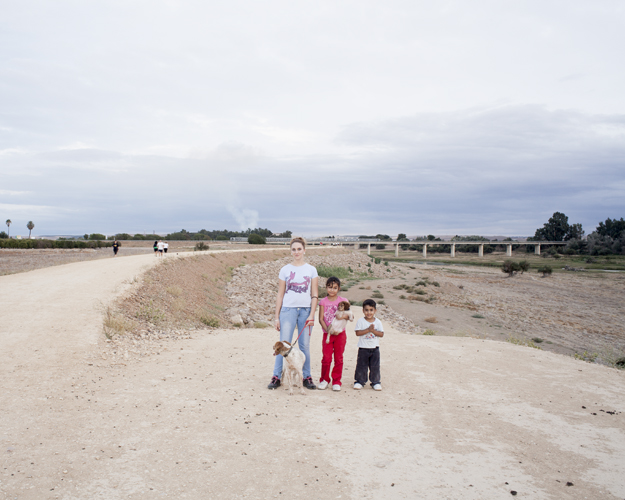
The human figure appears in my work, but rarely as the starting point. My project Andalucía was developed through a process that begins with landscape: light, spatial balance, the specific conditions of each site, and only then admits what happens to pass through the frame. Portraits were made with individuals encountered on location, without prior connection. Their presence is integrated without intervention, maintaining a neutral relation to the environment. The result is documentary photography in which figure and land coexist within a carefully constructed composition, neither element claiming absolute priority.
Landscape first, subject second
I select locations before I select subjects. That order is not a rejection of the human element; it is a way of protecting the work from becoming portraiture with scenery attached. Andalucían sites were chosen in advance for how they held space: proportion, distance, the way light fell across open ground or structured enclosure. The camera was set up for that spatial reading. When a person entered the frame, the question was not whether they were interesting as a character, but whether their presence completed or disturbed the composition already forming.
Large format enforces that hierarchy practically. On 4×5 colour slide film, you cannot follow movement with the fluidity of a handheld camera. You compose, then you wait. The landscape is stable; the figure is contingent. Sometimes the wait produces no figure at all, and the exposure belongs to land alone. When a figure remains in the final image, it has been tested against the same standard as any other element: does it belong to the spatial logic of the place?
This approach aligns with how my practice developed after early work in photojournalism. Daily news photography often inverts the order: event and person first, environment as context. Personal documentary work, for me, restored landscape as the primary language. Andalucía is where that restoration is most visible, because the figure is present but not dominant.
Encounters without staging
Every portrait in the series arose from encounter on location: no appointments, no direction, no staging. I did not ask individuals to perform a role or to stand where I indicated. Integration means accepting what the person offers: posture, distance, the relation they already maintain with the ground they occupy. The photograph records that relation rather than constructing a new one.
That restraint is ethical as well as formal. Without prior connection, the photographer's authority is limited, and should be. Large format already demands time; people notice the tripod, the cloth, the deliberate pace. An encounter under those conditions is never invisible. Neutrality, for me, means not exploiting that attention for spectacle, not turning a passer-by into a symbol of Andalucía, poverty, tradition or labour. The frame holds what was offered in the moment, within a composition shaped by the site.
Encounters without staging also distinguish this work from street photography as it is commonly practiced: the hunted moment, the unposed surprise, the quick withdrawal. My method is slower and more visible. What it shares with street-adjacent work is attentiveness to public space and to figures who did not expect to become photographs. What it refuses is the claim of theft: the image taken before the subject can object. Large format makes collaboration, however minimal, unavoidable.
Neutral presence in the frame
Neutrality does not mean absence of feeling. It means the human element does not perform for the camera or for a theme the photographer has decided in advance. In Andalucía, figures coexist with environment; they structure part of the image but do not overwhelm it. Compare this with Series Genets on Menorca, where the Menorcan horse appears as a dark contained form within landscape, a presence rather than a portrait subject. The logic is parallel: body as spatial fact, not as narrative centre.
Neutral presence requires editing as well as exposure. Not every encounter survives the sequence. Some images fail because the figure dominates; others because the figure feels illustrative: a type rather than a condition. What remains are frames where the person and the land share equal photographic seriousness, where removing either would collapse the image's meaning.
At print scale, approximately 120 × 100 cm in this project, that balance becomes physical. A figure too prominent becomes a portrait on a wall; a figure too distant becomes anecdote. The editing process asks whether the image still reads as landscape with a human element, or has crossed into another genre entirely.
Andalucían light and space
Andalucía offered conditions that suited this method: open light, clear spatial depth, land that reads without clutter. Locations were chosen for balance, not for picturesque association alone, but for how much structure the frame could hold. Light in southern Spain is often described in romantic terms; I use it functionally. Slide film commits to a specific rendering of that light at exposure. The Andalucían series depends on that commitment: warm tonal range, defined ground, sky that participates in composition rather than filling empty area.
Space, equally, is not backdrop. It is the argument the figure enters. A person standing in open land occupies a different relation than a person beside a wall, under trees, or at the edge of a path. Each site was selected for the relation it could offer, not generic Andalucían scenery, but specific conditions encountered in specific places. The work is titled with the region's name because the light and space belong to that territory, not because every image summarizes the whole of southern Spain.
Street-adjacent moments without street photography
I do not publish a street photography portfolio. My site is built around landscape, territory and long observation on large format film. Andalucía nonetheless contains what I would call street-adjacent moments: figures in public space, encounters unplanned, the social field briefly entering a practice otherwise devoted to land, infrastructure and pause. Acknowledging that adjacency matters for honesty. It prevents the work from pretending the human world does not exist.
But adjacency is not identity. Street photography, as a genre, privileges speed, proximity and the decisive moment. My work privileges composition, return and the authority of the site. The Andalucía series belongs to documentary landscape practice: described more fully on the page Large Format Photography in Spain: where colour slide film, slow exposure and exhibition-scale prints define the method across projects in Spain and abroad.
If a viewer approaches Andalucía looking for candid urban drama, they may find the work quiet, even static. That quietness is intentional. Figure and landscape, held in balance, produce a different kind of document: not the instant of public life seized, but the condition of a place at the moment a human presence aligned with its spatial logic. Documentary photography, for me, includes that alignment. It does not require the grammar of the street.
Manuel Pinar